Working translation: this English version should be reviewed by the project team before publication. The Polish text remains authoritative.
Introduction
About the project
The “Together in Poland — Bridges of Integration for Third-Country Nationals” project responds to the insufficient integration mechanisms available to foreigners in Poland, particularly in the Pomeranian Voivodeship.
In the face of growing migration, the project aims to create conditions that enable foreigners to adapt effectively to life in Poland, while supporting the receiving society in understanding and accepting cultural diversity.
The initiative is implemented in line with Poland’s “Comprehensive and Responsible Migration Strategy for 2025–2030”.
Direction
Main project objective
To provide multi-dimensional support for the integration of third-country nationals (TCNs) in Poland — both individually and socially — while counteracting racism and xenophobia and promoting openness and intercultural cooperation.
Priorities
Specific objectives
The project focuses on:
- supporting the active participation of foreigners in social and professional life,
- enabling them to learn Polish,
- promoting compliance with legal and social norms,
- building relationships between foreigners and local communities,
- providing social education to Polish residents,
- strengthening the skills of people who work with migrants.
Who it is for
Target groups
The “Together in Poland — Bridges of Integration for Third-Country Nationals” project covers a wide spectrum of participants, addressing the needs of both third-country nationals (TCNs) and the receiving society. The activities have been designed to support integration comprehensively and to involve all parties in the process.
1. Third-country nationals
People legally residing in Poland who need Polish language learning, assistance with residence legalisation, social and professional integration, and guidance on Polish legal and social norms.
2. TCN children and young people
Primary and secondary school pupils who need language and educational support as well as adaptation and integration activities in their school and local environment.
3. Public administration staff
Officials and representatives of public institutions who attend intercultural training, improve communication and service skills, and build knowledge about integration challenges.
4. The receiving society
Teachers, employers, NGOs and residents of the Pomeranian region taking part in information campaigns, integration events and educational activities.
The project actively involves all these groups in an integration process based on cooperation, mutual respect and openness. This will help build a cohesive and inclusive society that responds to migration challenges with empathy and responsibility.
Delivery
Key activities
- Polish language courses at different proficiency levels for children and adults.
- Training and counselling on law, administration and the operation of Poland’s institutional system.
- Social education through information activities and campaigns for the receiving society, aimed at increasing acceptance of the integration of foreigners.
- Labour market support through workshops, training and career counselling.
- Integration activities including meetings, events and initiatives that build relationships between Polish residents and migrants.
- Training for public administration and NGOs to improve their ability to serve and support foreigners.
- Psychological support for TCNs.
Outcomes
Expected results
Through the project we expect:
- increased knowledge of Polish among TCNs,
- greater legal and social awareness among foreigners,
- stronger TCN engagement in local communities,
- an improvement in their employment situation,
- greater acceptance of integration processes in Polish society,
- fewer instances of racism and xenophobia,
- stronger intercultural relationships and social cooperation.
Perspective
Long-term impact
The project will contribute to greater social cohesion in the Pomeranian Voivodeship and help build an open, inclusive society capable of responding effectively to migration challenges.
Key information
Project facts
- Total project value
- PLN 5,170,170.00
- European Funds contribution
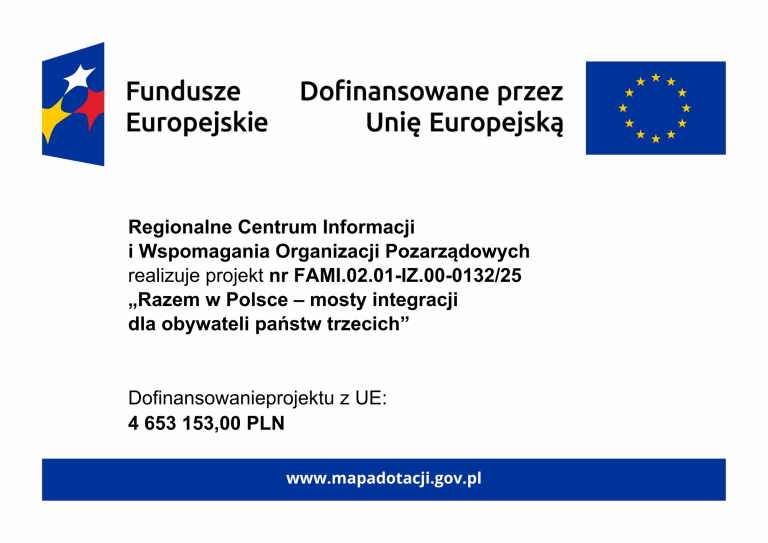
- PLN 4,653,153.00
- Funding source
- Asylum, Migration and Integration Fund 2021–2027
- Implementation period
- 1 Oct 2025–31 Oct 2028
- Project leader
- Fundacja RC
- Partner
- EDUQ Association in Lębork
- Project number
- FAMI.02.01-IZ.00-0132/25
- Hashtag
- #FunduszeEuropejskie